If your kid groans at the word “phonics,” melts down during reading practice, or has perfected the art of suddenly losing the ability to speak when you ask a question about a sound, this post is for you.
These are the best phonics games for kids who would rather do literally anything else.
Here’s what nobody tells you when your kid starts learning to read: some kids just don’t take to phonics naturally. And the more you push worksheets and drill-style practice, the more they dig in. I know because I lived it. That’s why I started looking for phonics games for kids that would actually hold my son’s attention.
What actually worked for us wasn’t making phonics feel like school. It was finding phonics games for kids that make it feel like play and sometimes, like getting away with something. These are the 10 tools that got my early-elementary kid from fighting me on every word to actually asking to play “swats.” I’m not exaggerating.
A quick note before we dive in: I’m not a reading specialist or an SLP. I’m a parent who had to get hyper-educated fast because, as first-time parents, we didn’t always know what was “normal” and when “he’s just a late bloomer” turned into “okay, that’s actually a problem.” I’ll link to trusted resources like UFLI and Reading Rockets in this post so you don’t have to take some stranger on the internet’s word for it. But I do want to be upfront: if your response to your kid struggling with a word is “sound it out,” you might want to brush up on the incredible science that’s been done around how kids actually learn to read. It’s different from how you and I learned. And it’s good. It will change your whole approach.
Okay. Let’s get into it.
1. Sight Word Swat (Best Phonics Games for Kids Who Need to Move)
Best for: The kid who can’t sit still
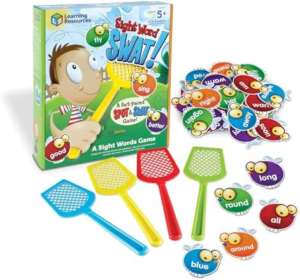
This is the phonics games for kids pick that changed everything for us. Your kid gets a fly swatter and smacks sight words as you call them out. That’s it. That’s the game.
Here’s why it works: I told my son that all rules are off and he can smack these things as hard as he wants. That made him feel a little mischievous…like he was getting to do something bad. And that tiny thrill of “I’m getting away with something” was enough to keep him engaged way longer than any worksheet ever could. If you have an active kid who needs to move, start here.
Ages: 5+ Where to buy: Learning Resources Sight Word Swat on Amazon
2. Really Good Stuff Word Building Sliders
Best for: Teaching word families (the cheat code to reading faster)
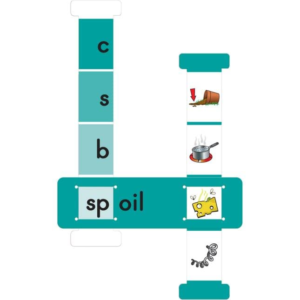
If there’s one thing I wish I’d understood earlier, it’s how important word families are. They’re basically cheat codes to learning more words faster. c-AT, b-AT, m-AT, s-AT. Once your kid sees that pattern, something clicks and suddenly they’re not sounding out every single word from scratch.
These sliders make that pattern impossible to miss. But here’s where it gets fun: don’t just let them use the picture side. Turn the slider toward your kid, randomly slide it to a different letter, and have them shout out the word as fast as they can. Then (and this is the secret weapon) make them do it in funny voices.
“This is robot round! Say the words like you’re a robot.” Then monster round. Then whisper round. Then opera round. Don’t overthink the voices. The sillier, the better. Give your kid the space to be creative and they’ll keep themselves engaged without you having to do much at all.
Ages: 5-7 Where to buy: Really Good Stuff Word Building Sliders on Amazon
3. Snap It Up (A Fast-Paced Phonics Games for Kids)
Best for: Leveling up from recognition to actually building words
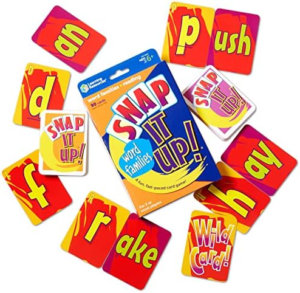
Once your kid is nailing the quick recognition from the sliders, this steps it up, because now they need to think through what they can form with the letters they have. This is encoding practice, and encoding is very likely not getting hammered enough at your kid’s school. But it is critical.
Think about it this way: if you give someone a multiple choice question, they have a 25% chance of getting it right just by guessing. But a fill-in-the-blank question? A short response? That’s how you really know whether they’ve mastered the skill. The more cues and scaffolds you can gradually remove, especially when you’re connecting decoding (reading) and encoding (spelling), the stronger you’re making those neural pathways.
This game does that work in a way that feels like a card game, not a quiz.
Ages: 6+ Where to buy: Learning Resources Snap It Up Phonics on Amazon
4. ThinkFun Zingo Sight Words
Best for: Hammering sight words into automaticity (but NOT as a starter game)
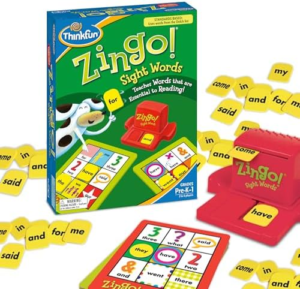
Okay, here’s where I went wrong with phonics games for kids so you can learn from my mistake.
This is not the game you introduce in the first few weeks of sight words. Especially if your kid has played the original Zingo. The jump is HARD and they will get discouraged. I watched it happen in real time with my son and it set us back. He hated Sight Word Zingo AND Original Zingo. Woof…
Use Zingo Sight Words when your kid can recognize the words about 50% of the time. At that point, this game becomes the perfect way to hammer them into automaticity. The speed, the competition, the satisfying click of the Zingo machine…it makes the kind of repetitive practice that actually cements sight words feel like a race, not a chore.
It’s perfect for late kindergarten and early first graders who need that bridge from “I’ve seen this word before” to “I know this word instantly.”
Ages: 5-8 Where to buy: ThinkFun Zingo Sight Words on Amazon
5. hand2mind Elkonin Box Floor Mat Activity Set
Best for: Kids who need to MOVE to learn
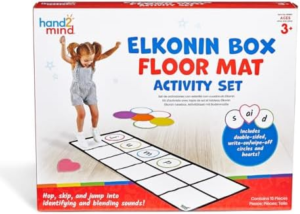
Your kids are being taught phonics with Elkonin boxes at school. If you don’t know what they are, look them up; UFLI and Reading Rockets both have great explainers. The short version: it’s a visual and tactile way to break words down into their individual sounds, using boxes that represent each sound in a word.
When you are looking at phonics games for kids who struggle to sit still, the tabletop version of this (tapping or pushing chips into boxes) works fine. But if you have an active kiddo, this is what you want. This is the gross motor, full-body version. Big hops between sounds burn energy AND make the practice stick.
Mix up the hopping by asking for different animal styles: elephant stomp, kangaroo hop, crab walk, bunny jump. It takes a simple phonics exercise and turns it into something that gets the wiggles out while building a foundational skill.
The principles behind Elkonin boxes are simple once you understand them. Spend 20 minutes watching some UFLI videos online and you’ll feel completely comfortable leading this activity at home.
Ages: 5-7 Where to buy: hand2mind Elkonin Box Floor Mat on Amazon
6. hand2mind Reading Rods
Best for: Hands-on spelling (encoding) practice
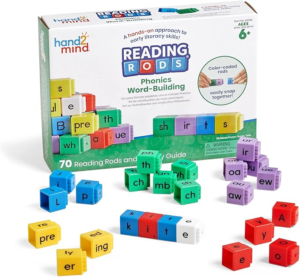
These are basically connector blocks with letters on them: think building blocks meets spelling practice. They’re great for encoding because the act of physically locating and grabbing the right letters uses different parts of the brain than just writing or typing.
Try placing them in alphabetical order first, then mixing them up. You can also spell a word with the rods and take a block or two out (this is especially good when you’re working with vowel teams and r-controlled vowels).
A reality check though: for my ADHD kid, this was a quick activity. Maybe 10 words on the BEST day, but I only ever planned to get 4-5 in. It can get boring fast (and it’s hard!), but it’s a really effective way to practice. Just be mindful of the mental tax your kid is paying. When their eyes start glazing over, it’s time to stop. Immediately. It’s hard to come back from pushing them over the edge with a particular tool. Even if you only got through three words. That’s okay. Three words with full focus beats ten words while they’re checked out. And it really beats them associating the thing with a bad feeling.
Ages: 5-8 Where to buy: hand2mind Reading Rods on Amazon
7. hand2mind Talking Mirror My Sounds
Best for: Kids who are also struggling with articulation
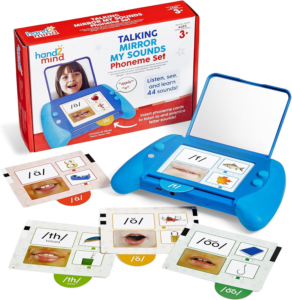
If your child is struggling with certain sounds (ex. L’s and R’s still sound like W’s) this mirror combined with a simple voice recorder can be a game-changer. Here’s why: when you correct your child’s pronunciation, you’re only tickling one sense. But if they’re saying the word while looking in the mirror, watching how their mouth and tongue are set up, they can make tiny tweaks until they get it right. Then they have a “feel” and a “look” for how the sound gets constructed.
I need to be honest with you here, parent to parent: if your kid is in kindergarten and certain sounds aren’t right, it’s time to pay attention. The smiles I got from hearing my kindergartener say “piwwow” — I would give every single one of them back to not have him struggle with that L sound in second grade. What seems cute at 5 becomes an entrenched pattern by 7.
I’m not an SLP. But as a parent who had to get hyper-educated fast, I can tell you: sometimes “he’ll grow out of it” turns into “we should’ve acted sooner.” Sometimes you’ll get a teacher who clocks it and provides extra support or makes a referral, but keep in mind they also have 20 other kids to worry about every day. Things slip through the cracks. Be the one who catches it.
UFLI and Reading Rockets are widely respected, evidence-based resources if you want to educate yourself. You don’t need a certification, you just need to be an active participant.
Ages: 4-7 Where to buy: hand2mind Talking Mirror My Sounds on Amazon
8. Learning Resources Let’s Spell S’mores (+ The Kit Rotation Hack)
Best for: CVC word practice, with a bonus hack to connect with other parents
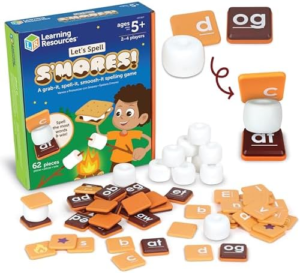
For CVC (consonant-vowel-consonant) words, there are dozens of high-quality tactile kits like this s’mores set that are super fun… but they’re short-lived. Kids get bored of the same one quickly, and at around $20 each, you can easily panic-spend $100 buying the same toy in different flavors.
Here’s what I’d actually recommend: start a CVC kit rotation with other families.
Send your room parent an email and ask if they can reach out to the class. Each interested family buys ONE kit. Then you rotate them on an agreed-upon schedule (weekly keeps it fresh and “forces” you to use it before you “lose” it). The hardest part is the actual swaps, but in K through 2nd grade, a parent usually has to physically get out of the car and hand-off with the teacher anyway, so that pickup moment is a natural time to make the exchange. Also, sometimes parents would leave tips inside the boxes or write funny little notes like “Do this on a weekend when you can actually make REAL s’mores, or be prepared for big feelings.”
At the end of the year, you have options: we offered to donate ours to the classroom (newer teachers are usually thrilled to get materials like this) or check with your school library, some loan out games just like books.
If the communal approach isn’t your thing, godspeed. Just know what you’re getting into on the spending side.
Ages: 5-7 Where to buy: Learning Resources Let’s Spell S’mores on Amazon
9. Sight Word & Phonics Flash Cards
Best for: Visual learners who need a little extra scaffold
I know, I know. Flash cards suck. Let’s be honest.
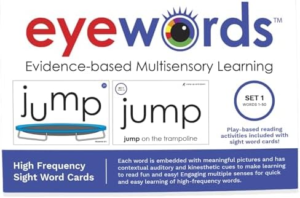
But these are actually good. The words have visual illustrations built into the letters, and that tiny extra visual cue can sometimes help kiddos who are struggling get across the finish line. This works for both decoding and encoding; my son would close his eyes during spelling practice and tell me he was “pulling up the card” in his mind, and then he’d spell the word correctly.
You may not want to use the full set. See which words they’re struggling with and pull just those cards out. Combine them with a few cute mnemonics and you’ve got a nice scaffold to hold them up until the words become automatic. Think of them as training wheels…they come off eventually.
Ages: 5-8 Where to buy: Sight Word & Phonics Flash Cards on Amazon
10. I Can Read Word Search (A Quiet Phonics Games for Kids Option)
Best for: Making reading practice feel like a treat
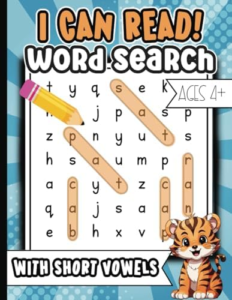
Word searches are a really fun way to practice spelling and word recognition, but it’s nearly impossible to find ones that are appropriate for newer readers. Most of them throw in words that are way too advanced and it defeats the whole purpose.
This set is designed for early readers, so they can actually start enjoying the thrill of finding words right away. And if you’ve ever checked something off a to-do list, you know: scratching off a found word hits that same deeply satisfying button.
Once my son got comfortable, I’d pretend to “race” him to find words. Beating mom in ANYTHING is a win on multiple levels: confidence boost, engagement boost, and he didn’t even notice he was practicing reading.
Ages: 5-8 Where to buy: I Can Read Word Search Book on Amazon
Tips for Choosing Phonics Games for Kids Who Resist Practice
Start with movement. If your kid hates sitting down to practice, don’t make them sit down to practice. Sight Word Swat, the Elkonin Box Floor Mat, and even just standing up to use the Word Building Sliders can make a huge difference.
Decoding and encoding are a team. Reading (decoding) and spelling (encoding) reinforce each other. Don’t just practice one. The Word Building Sliders and Snap It Up are great for bridging the two.
Know when to stop. When their eyes glaze over, you’re done. Five focused minutes beats thirty minutes of fighting. Protect their relationship with reading above all else.
Don’t panic-buy. It’s really tempting to throw money at the problem. The kit rotation idea in #8 will save you hundreds and give your kid variety, which is what actually keeps them engaged.
Educate yourself — just a little. You don’t need to become a literacy instructor. But spending an hour on UFLI and Reading Rockets will give you a completely different lens on how to help your kid. It changed everything for us.
If you found this helpful, pin it for later — and send it to the group chat, because I promise you’re not the only parent in your kid’s class Googling this stuff at 10pm.
This post contains affiliate links, which means I may earn a small commission if you make a purchase through them — at no extra cost to you. See my full affiliate disclosure for details.
Have a game or tool that’s worked for your family? Drop it in the comments. We’re all in this together.