What if everything we’ve been saying to kids with ADHD is actually making things harder?
Not because we mean harm. Because we don’t have the right words yet.
“You need to focus.” “Try harder.” “Just slow down for two seconds.” These land so reasonably in our heads. To a child with ADHD, they feel like being told to control the weather. The child isn’t choosing to disengage. Their brain works differently, and the way we talk about that difference carries more weight than most of us realize.
There’s an analogy that changed everything in our house. I think it might do the same for yours.
The Ferrari Analogy
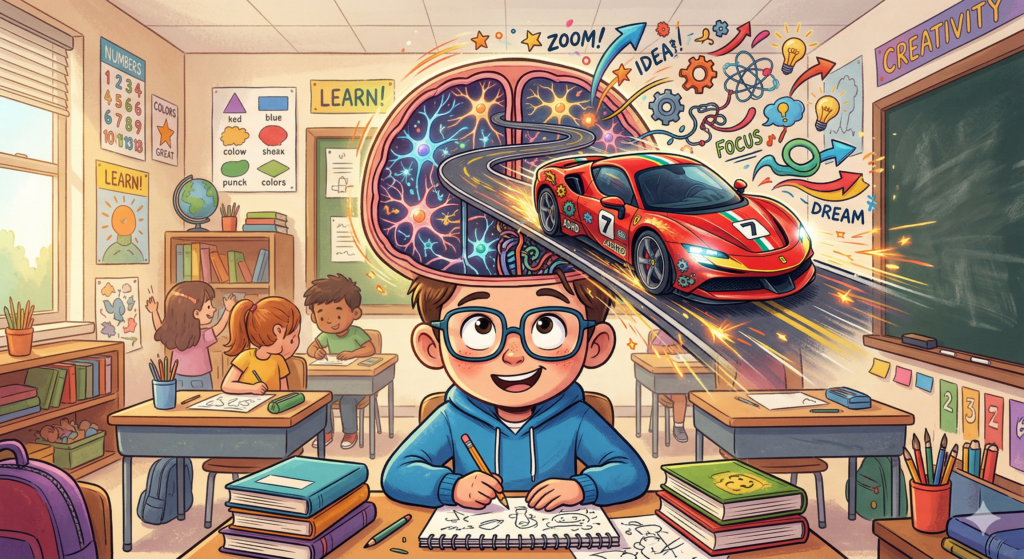
Picture a Ferrari. Stunning, fast, built with a ridiculous engine. That’s the ADHD brain. Big horsepower. Exceptional processing in the areas it cares about. The kind of creative intensity and divergent thinking that a lot of neurotypical brains simply can’t replicate.
Now picture that Ferrari with bicycle brakes.
That’s what’s happening with the prefrontal cortex in kids with ADHD. The prefrontal cortex handles impulse control, planning, attention regulation, and the ability to pause before acting. And in children with ADHD, that region develops more slowly than in neurotypical kids.
According to research from the National Institute of Mental Health, the brains of children with ADHD develop in a normal overall pattern, but maturation is delayed by about three years on average. The lag is most pronounced in the prefrontal cortex. In some areas of the prefrontal cortex, that delay can stretch to five years.
The engine isn’t the problem. The brakes are still forming.
So when you ask your child to “stop and think before you act,” you’re asking their brake system to do something it isn’t fully wired to do yet. Not because they’re lazy. Not because they’re making a choice. Because the hardware is still under construction.
Why This Reframe Matters
Here’s what my son absorbed for years before we found this language: “You’re not trying hard enough.” “You know better.” “Why do you keep doing this?”
All of those messages, even the well-meaning ones, landed as character judgments. And when a kid with ADHD starts to internalize the idea that their behavior reflects who they are as a person, the shame accumulates fast.
The Ferrari analogy does something different. It separates the child from the struggle.
“Your brain is like a Ferrari. A really cool, fast, powerful car. But your Ferrari brain has bicycle brakes. Not because something is wrong with you. Because your brakes are still developing.”
And then the reframe that really matters: “This isn’t because you’re not trying. It’s because your brakes are still forming. Brains grow. Brakes can be built.”
For a child who has spent years hearing that they’re difficult or disruptive or falling short of their potential, this reframe is genuinely profound. It shifts the story from “what’s wrong with you” to “here’s what’s happening, and here’s how we help.”
It also changes how the child relates to their own frustration. Instead of “I’m broken,” the narrative becomes “my regulation system needs support right now.” That’s a foundation you can actually build something on.
What Support Looks Like While the Brakes Are Developing
Understanding the Ferrari brain isn’t just about shifting language. It changes how you build support around your child day to day. If the brakes are still forming, your job isn’t to punish their absence. It’s to serve as external brakes while the internal ones develop.
Here’s what that looks like in practice.
Moving bodies. Physical movement is one of the most reliable tools for helping regulate the nervous system in a child with ADHD. Exercise increases dopamine and norepinephrine, the same neurotransmitters targeted by ADHD medication. A five-minute movement break before homework, a walk around the block, a few minutes of jumping: these aren’t distractions from focus. They’re the conditions that make focus possible.
Co-regulation before self-regulation. Children learn to regulate themselves by first regulating alongside someone else. According to the Child Mind Institute, co-regulation is the process by which caregivers provide calm, steady support that helps a child’s nervous system settle down. Before your child can self-regulate, they need a regulated adult to co-regulate with. Sitting close, lowering your voice, slowing your breathing: these aren’t soft parenting options. They’re neurologically sound strategies that lay the groundwork for independent self-regulation over time.
Breaking tasks into pieces. A multi-step task can feel cognitively enormous to the ADHD brain, not because of a lack of intelligence, but because the executive function system that sequences tasks is still developing. Three numbered steps on a sticky note don’t coddle a kid. They give the developing prefrontal cortex a scaffold to work with.
External structure as a stand-in for internal structure. Visual checklists, timers, consistent routines: what the internal executive function system can’t yet provide, the external environment can. Over time, these external supports become internalized. That’s the whole goal.
The Long Game
Here’s the part I want every parent of a kid with ADHD to hold onto when the days get hard.
The same traits that make childhood difficult, the intensity, the divergent thinking, the risk tolerance, the ability to hyperfocus on something meaningful, these are the traits that translate into real strengths in adulthood when they’re supported well.
Research published in Frontiers in Psychiatry found that adults with ADHD often report higher rates of real-world creative achievement than their neurotypical peers. A study in the Academy of Management Perspectives found that ADHD traits including impulsivity, risk tolerance, and unconventional thinking are associated with entrepreneurial behavior and new business creation. The same kids who can’t sit still in third grade are often the ones who build companies, lead teams, and thrive in high-stakes environments that would overwhelm people with slower engines.
“And one day, with a really fast engine and strong brakes, you’re going to go places most people can’t.”
That’s not just something nice to say. It’s what the research shows, over and over, about what becomes possible when kids with ADHD receive the right support during the years their brakes are still forming.
The goal isn’t to turn the Ferrari into a different car. The goal is to build brakes good enough to match the engine.
How to Use This With Your Child
Don’t introduce the analogy in the middle of a meltdown. Save it for a calm moment: dinner, a car ride, a quiet evening. Keep the explanation simple and short. Ask what they think. Let them sit with it.
Then build shared language from it. When you see the engine running hot, try: “Your Ferrari’s going fast right now. What can we do to help the brakes?” You’re not calling out bad behavior. You’re inviting collaboration instead of escalation.
Let your child use the language too. “My brakes aren’t working right now” is so much more useful than “I can’t help it,” because it names what’s actually happening and opens the door to problem-solving together.
And remind yourself, often: your child isn’t choosing to struggle. They are working with a brake system that isn’t finished yet. Your job, for now, is to be part of the brakes while theirs grow stronger.
Action step: This week, find a quiet moment to share the Ferrari analogy with your child. Keep it short, use simple words, and then listen. Notice what they say. It might be the start of a completely different conversation.