If your kid rolls their eyes every time you pull out a phonics workbook, I get it. Mine does too. But here’s the thing: some of the best phonics practice doesn’t look like phonics practice at all.
These five books have become staples in our house because they teach real reading skills while actually being fun. No bribing required.
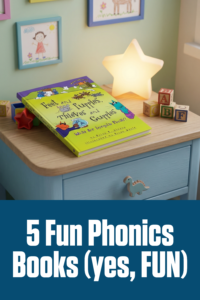
Feet and Puppies, Thieves and Guppies: What Are Irregular Plurals?

This one is sneaky good. Most kids learn early on that you just slap an “s” on the end of a word to make it plural. Dog, dogs. Easy. But English is chaos, and at some point your kid is going to run into words like “feet” and “mice” and “children” and wonder what happened to the rules they just learned.
This book tackles irregular plurals in a way that actually sticks. It introduces the patterns (yes, there are patterns, even in the irregular ones) through fun examples that kids remember. If your child is at the stage where they’re reading more complex text and stumbling over plurals that don’t follow the rules, this is a great one to have on the shelf. It reinforces morphology, which is a fancy way of saying it helps kids understand how words are built and how they change. That’s a huge piece of the reading puzzle.
The Very Helpful Floss Rule

If you’ve never heard of the floss rule, here’s the quick version: when a one-syllable word has a short vowel followed by f, l, s, or z, you usually double that final consonant. Think “stuff,” “hill,” “mess,” “buzz.” It’s one of those spelling rules that makes a huge difference once a kid internalizes it, because suddenly a whole chunk of words become predictable instead of random.
This book teaches that rule in a way that’s engaging and doesn’t feel like a textbook. For kids working through phonics patterns, especially if they’re in Orton-Gillingham or any structured literacy program, the floss rule is foundational. Having a book that reinforces it through story rather than worksheets is really valuable. Your kid absorbs the pattern while just enjoying the read.
Very Short Stories to Read Together

This one is a favorite in our house. The format is designed for you and your child to take turns reading. There’s a part for you and a part for them, and you go back and forth through each short story.
Here’s why that’s so powerful for a reluctant reader: it mentally lightens their load. Instead of staring down a full page of text they have to get through alone, they’re sharing the work with you. That alone can take the anxiety down a few notches. But the real magic is that while you’re reading your parts, your child is hearing fluent reading. They’re absorbing your prosody, which is the rhythm, expression, and pacing of natural speech. Prosody is one of those skills that’s hard to teach directly, but kids pick it up when they hear it modeled consistently. So every time you read your section with good expression, you’re giving them a mini fluency lesson without either of you even realizing it.
Plus, the stories are short. For a kid who gets overwhelmed by long text, that matters more than people think.
Big Words for Little Geniuses

Okay, fair warning: you will probably need to sound out some of these monster words yourself. And honestly? That’s one of the best things about this book.
When your kid watches you slow down, break a word apart, and work through it syllable by syllable, two really important things happen. First, they see that decoding is something everyone does, not just struggling readers. You’re normalizing the process of figuring out hard words. Second, they get a front-row seat to your decoding strategies in action. They see you use the skills you’ve been trying to teach them, and it clicks in a way that instruction alone sometimes can’t deliver.
On top of all that, this book introduces some seriously impressive vocabulary. Kids love knowing big words. There’s something about being seven years old and casually dropping “metamorphosis” at the dinner table that just lights them up. And when the grown-ups react? Forget about it. That confidence boost is real, and it builds a positive association with reading and language that carries forward.
The Gato Taco

This book puts a fun twist on rhyming words, and it opens the door to a really cool conversation about how rhyming actually works. Some of the rhymes in here are perfect, one-to-one matches. But some of them are close rhymes, not exact. And that’s where it gets interesting.
You can use those almost-rhymes to talk with your kid about what makes a “real” rhyme versus a near rhyme. That kind of phonological awareness (being able to hear and compare the sounds in words) is a core building block of reading. Kids who can hear subtle differences in word endings are building the ear training they need for decoding and spelling later on.
And if you want to take it one step further and go full nerd with it? Look up how rappers use near rhymes and slant rhymes to make their lyrics work. It’s an incredible skill. Artists like Eminem are masters at bending words so they almost rhyme, and understanding that concept honestly gives kids a deeper appreciation for how flexible and creative language can be. It turns a simple picture book into a real conversation about the art of words.
The Bottom Line
None of these books feel like homework, and that’s the whole point. The best phonics practice for a reluctant reader is the kind they don’t realize is phonics practice. These five have earned their spot on our bookshelf because they teach real skills (irregular plurals, spelling rules, fluency, decoding, phonological awareness) while keeping things light and fun.
This post contains affiliate links, which means I may earn a small commission if you make a purchase through them.
If you want to see more of our favorite learning tools, check out My Favorite Homeschool Tools for the full list of what we actually use and love.