There is a version of every morning that involves my husband following my son from room to room, reminding him of every single thing he needs to do before we leave. Shoes. Backpack. Water bottle. Did you brush your teeth? Go back and brush your teeth.
It is exhausting for both of them. And it does not actually build the skill we want him to have, which is the ability to move through a routine without us managing every step of it.
So we changed the system.
First: Understanding Time Blindness
Before I talk about what we use, I want to talk about why this is genuinely hard for kids with ADHD, because it is not a character flaw and it is not about not caring.
Time blindness is a real and well-documented feature of ADHD brains. It is not about forgetting what time it is. It is about not being able to feel the passage of time the way a neurotypical person does. For most people, there is an internal clock that creates a kind of background awareness of how much time is passing. For kids with ADHD, that internal clock either does not run reliably or does not register consciously.
What this means in practice is that 10 minutes and 30 minutes feel about the same. The future feels abstract and far away until it is suddenly right now. A task that should take five minutes can absorb an entire morning without the child (or adult!) registering that time is passing.
If you want to read more about how this works:
- ADHD and Time Blindness via Understood.org
- How ADHD Warps Time Perception via ADDitude
- Losing Track of Time? How to Manage ADHD Time Blindness via ADDitude
I understood this concept because I live it. I have adult strategies that I use to cope, but most of them won’t work for kids. Also, my neurotypical husband could not, for the life of him, understand why our son couldn’t just do the things we asked him to do, especially things that are the same EVERY. SINGLE. DAY. He would basically follow him around in the morning and remind him over and over what needed to be done. No fun for him and no fun for our son.
Helping him understand this changed how we approached our routines. The nagging was not making our son more aware of time. It was just making us the external substitute for the internal clock he does not have. The goal became building external structures that could do what nagging was doing, but without us having to be the ones doing it. We nag less, he feels more independent and confident.
The System We Use
We have three tools working together: keychain checklists that travel with him, checklists posted around the house, and a visual timer for the morning. None of these are magic and none of them solved everything overnight. But together they shifted us away from me managing his whole day and toward him having the information he needs to manage himself.
Keychain Checklists for Every Bag
These are small checklist boards that attach to the inside of a bag with a safety pin or by hooking through an existing loop. Ours live inside his school bag, his swim bag, and his travel bag.
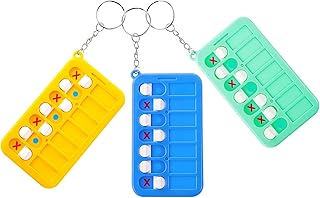
The point is not that they are visible from the outside. The point is that he knows they are there. When he opens the bag, the checklist is right there telling him what he needs before he leaves or what to do when he arrives. Pack your suit. Goggles. Water bottle. Does not matter if he can remember the list. The list remembers for him.
We keep them inside the bags rather than clipped on the outside specifically so other kids do not notice them. He knows it is there. Nobody else has to.
Keychain checklist pendants on Amazon
Checklists Around the House
For the house, we are not going for fancy. We use a basic sliding checklist board that comes in a four-pack, and we flipped the paper inserts over and wrote our own items on the back.
We have one by the front door for unpacking from school (hang up backpack, put lunchbox on the counter, put papers on the desk). One in his bedroom for daily habits (clothes in the laundry bin, make the bed, turn off lights when you leave). One in the kitchen for his responsibilities there (load or unload the dishwasher depending on the day, put away any toys that ended up there, feed the dog).
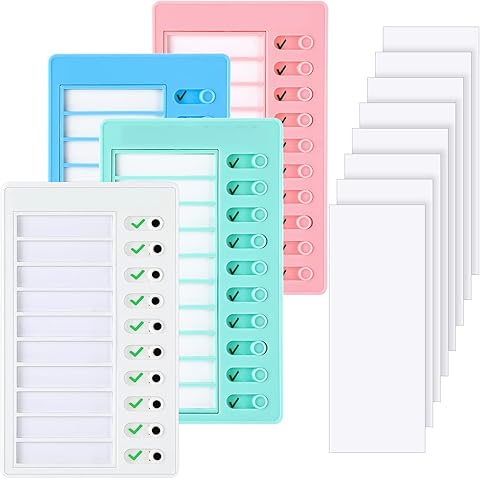
The four-pack is cheap enough that you are not worried about one getting damaged. The sliding mechanism means he can physically move each task over when it is done, which is satisfying in a way that makes him more likely to actually use it.
Sliding chore chart 4-pack on Amazon
If you want something with more visual structure or a built-in timer component, there are planning board options that combine a visual schedule with a countdown timer:
The Morning Timer
This one is the tool I would spend more money on.
We put it on the counter during the morning routine. It counts down whatever time we have set, and he can see exactly how much time is left. It is not a substitute for the internal clock he does not have, but it is the closest external approximation we have found. Instead of me saying “we have 20 minutes,” there is an actual visual representation of 20 minutes disappearing in real time.
Time blindness is time blindness. There is no product that fixes it. But having a visible, moving representation of time does help in a way that verbal reminders do not. And over time, there is value in him starting to connect what a countdown timer looks like with what a clock face looks like. It is a slow build, but the association is worth starting early.
Two options worth looking at:
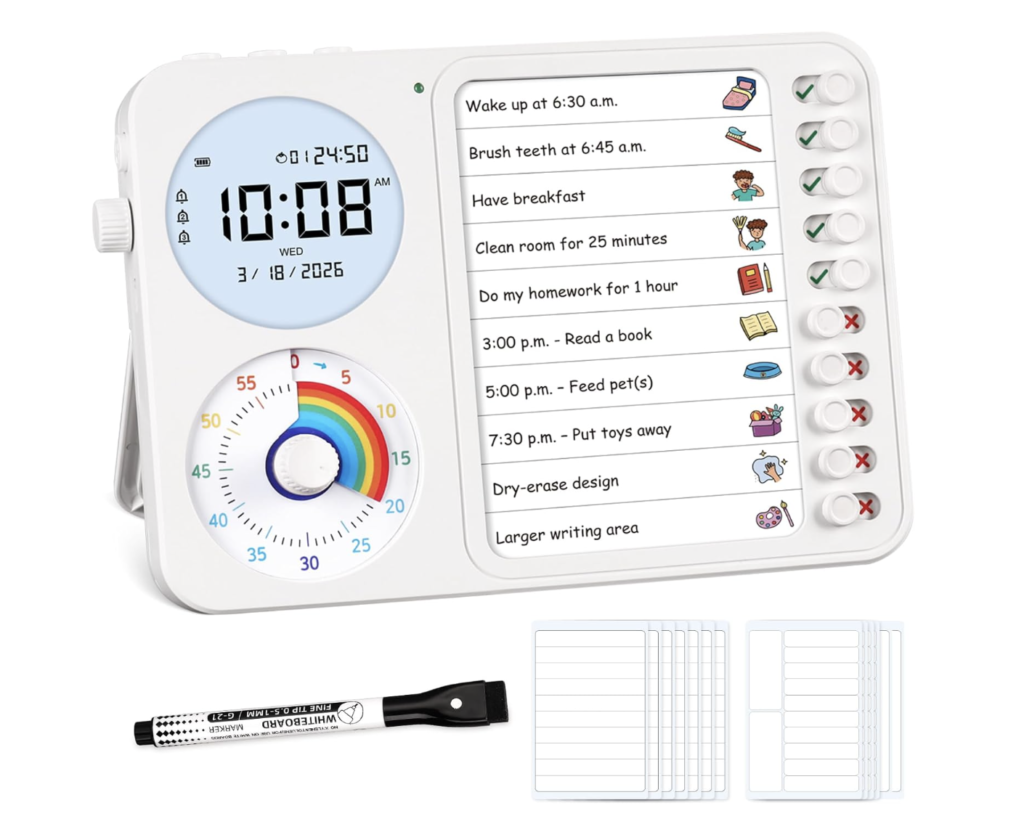
- Visual timer, option 1: this is the one we use; it shows both the countdown and an analog clock, which helps start building the connection between the two
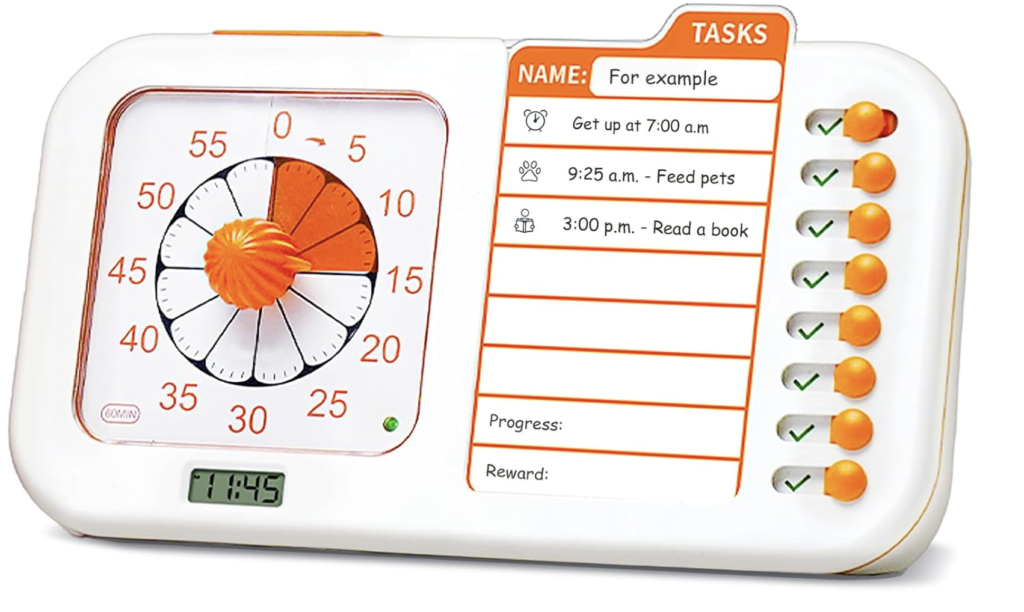
- Visual timer with clock face, option 2: solid visual countdown timer. If you feel like the other one is a little too cluttered.
Need To’s Before Want To’s
The checklists and timer handle the “what” and “when.” The other piece of our system is the philosophy behind it, and it is simple: we do our need to’s before our want to’s.
When he asks to play Minecraft or watch YouTube, the first step is not negotiation. It is the list. Did you do what’s on the list? If yes, then yes. If not, then not yet. That is the whole conversation.
We do not reward him for completing the items on the list. Unloading the dishwasher, feeding the dog, making his bed: these are not favors he does for us. They are parts of what our family does together. We do not give him a gold star for being a member of the household. We give him the dignity of being a member of the household.
What Rewards Are Actually For
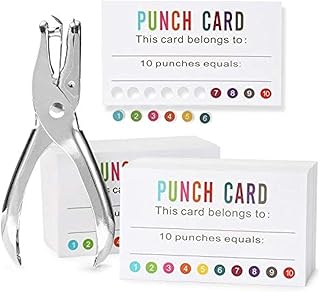
Rewards in our house are for going above and beyond. When we ask him to do something extra that is not on his regular list, like running the vacuum when it is not normally his job, he gets a punch on a punch card. When the card is full, he redeems it for something off his reward list: 20 extra minutes of Minecraft, choosing what is for dinner, a movie night pick.
This keeps the reward tied to real effort without turning every basic expectation into a transaction. He knows the difference between what we all just do and what actually earns something extra.
What We Have Noticed
The mornings are not perfect. There are still days where someone is dragging and the timer runs out and we are scrambling. But the dragging is no longer my fault or his fault or a product of either of us being bad at this. There is a system, and sometimes the system is hard to follow. That is a much more manageable conversation than the one where I am the nag and he is the kid who never listens.
He is also genuinely more proud of himself on the days the list gets done without me prompting it. That matters more than the dishes.
About Decoding Mom
Decoding Mom is written by a mom of a bright kid with ADHD and mild dyslexia. After too many late-night research binges trying to make phonics fun, she started this site to translate the science of reading, IEPs, and special-ed assessments for parents figuring it out the hard way. Honest, parent-first, no fluff. More about her here →
Leave a Reply