You used to read to them every single night. They used to beg for “one more chapter” when you said it was bedtime. They had favorite series. They knew authors’ names. They wanted to read. Now? Kids reading for fun feels like a distant memory.
The books sit on the shelf gathering dust. The tablet wins every single time. The Netflix app gets tapped 100 times before you even suggest a book. If your kid stopped reading for fun, you’re not alone.
The first instinct is to blame screens. And yeah, screens are competing for attention in ways they didn’t ten years ago. But the research shows something more complicated and, honestly, more fixable than just taking the iPad away.
Kids Reading for Fun Is Dropping Fast
Federal data from the National Endowment for the Arts tells a story that should concern every parent. Daily pleasure reading dropped from 53% of 9-year-olds in 2012 to 39% in 2022. That’s a 14-point drop in one single decade.
For teenagers it’s worse. 31% of 13-year-olds now never or hardly ever read for fun. That’s nearly a third of all teenagers who never open a book unless forced to for school.
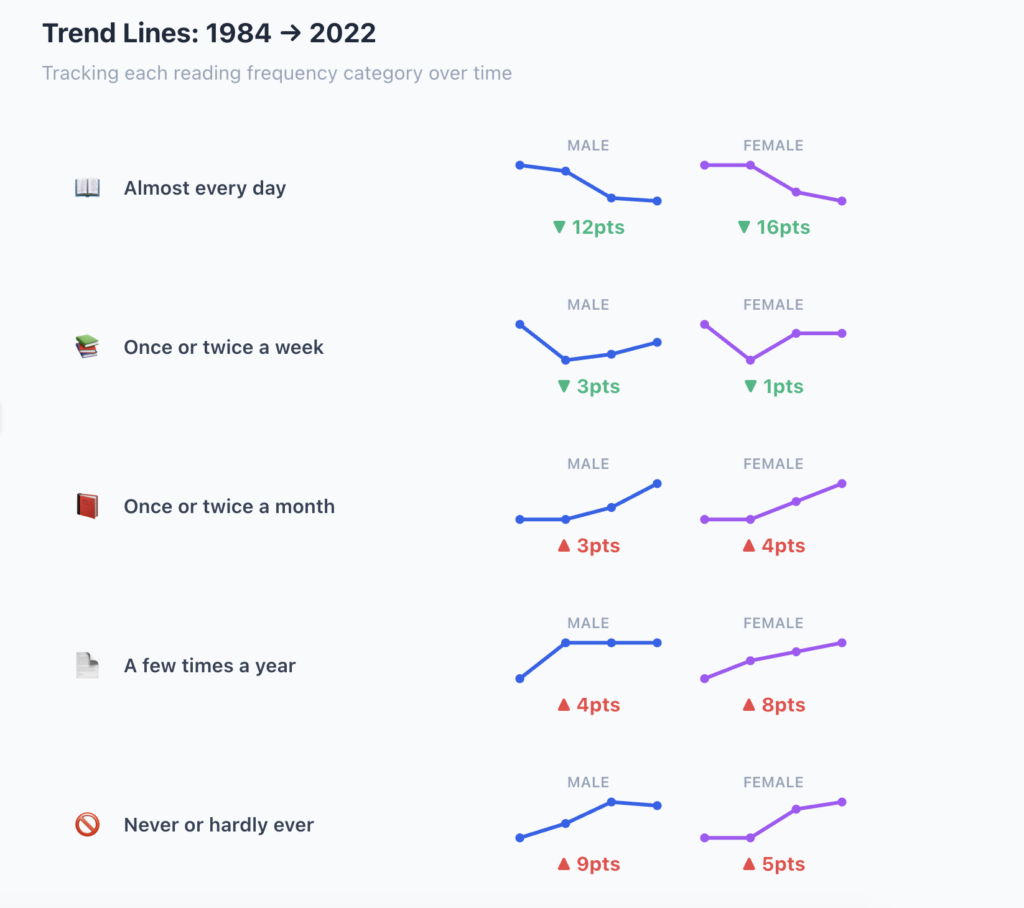
The decline has been steady and relentless. Recent analysis of 20-year trends shows the slide accelerating, especially after 2015. This isn’t a pandemic blip. This isn’t a temporary dip. This is a decade-long trend that’s getting worse.
We live in a moment where an entire generation is growing up without pleasure reading. Kids reading for fun has become the exception, not the norm. That’s a shift so big it’s easy to become numb to it. But if you think about what’s being lost, it’s staggering.
It’s Not Really About Screens (Though Screens Don’t Help)
Here’s where it gets interesting: this isn’t actually a screen problem. Or rather, it’s not just a screen problem.
It’s a reading identity problem.
Kids who struggle with reading stop seeing themselves as readers. Not eventually. Right away. The moment reading becomes hard, they decide they’re “not a reading person.” They opt out. They choose literally anything else. And once that identity calcifies, once they’ve internalized the belief that reading is not for them, it’s incredibly hard to shift. (This is also why asking about reading levels misses the bigger picture.)
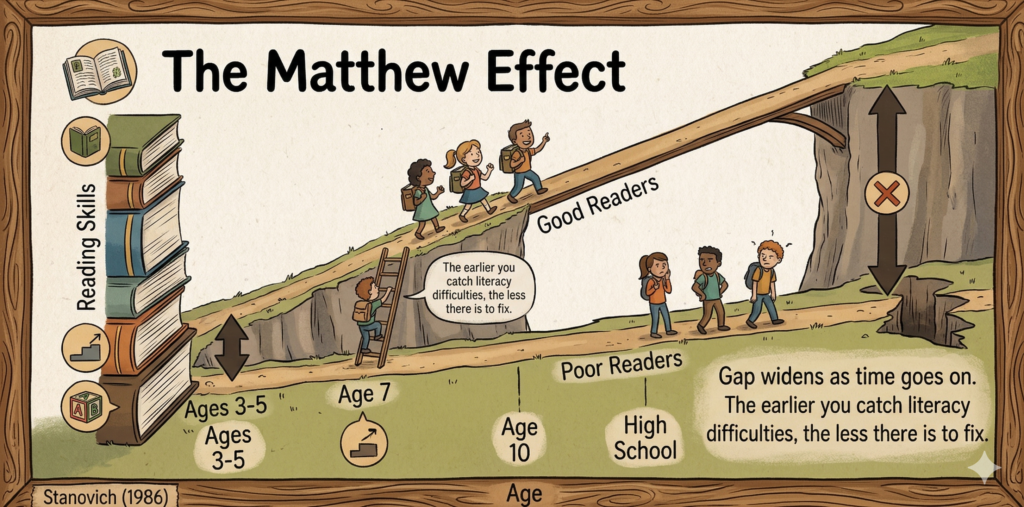
This is called the Matthew Effect, named after Keith Stanovich’s research on reading development, and it explains something that keeps so many parents up at night. Good readers read more, which makes them better readers. Struggling readers read less, which makes them fall further behind. It’s a vicious cycle that compounds over years, creating a growing gap.
But here’s what’s important: the cycle isn’t inevitable. And it doesn’t start with screens. It starts with whether your child sees themselves as a reader. If you want to get your kid reading for fun again, the fix is less about screen limits and more about identity. For kids with ADHD, that identity piece is even more complex, because their brains are wired to need higher engagement to stay locked in.
A child who decided they’re “not a reader” won’t pick up a book even if you remove every screen in the house. A child who still sees themselves as a reader will read despite the competition. Identity comes first.
How Reading Identity and Motivation Connect
Motivation and comprehension aren’t separate things. They’re woven so tightly together that you can’t pull them apart. Research clearly shows that motivation directly impacts comprehension. A kid who cares about understanding text will work through confusing parts, will reread, will ask for help. A kid who has decided they hate reading will skip the hard parts and tune out.
This is why a struggling reader can suddenly breeze through a book about their special interest. The motivation changes everything. The same brain that “can’t focus on reading” can read Reddit threads about their obsession for hours. The difference isn’t the brain. It’s whether they care.
One of the biggest factors in reading motivation is something so simple it almost sounds ridiculous: choice.
When kids get to choose what they read, engagement skyrockets. Research on choice and reading motivation is pretty unanimous: autonomy matters profoundly. A kid who picks their own book is infinitely more likely to actually read it than a kid assigned one they don’t care about.
But here’s the part that trips parents up. Most of us have a very narrow definition of “real reading.” We’re thinking novels. Chapter books. Literature. The classics they’ll read in high school. And when our struggling reader wants to read graphic novels or manga or browse Reddit or listen to audiobooks instead, we wonder if that actually counts.
It does.
Why Reading Volume Matters More Than We Think
Research on reading volume and vocabulary shows that the amount kids read matters enormously. Not the type of reading. Not the format. The amount. A kid who reads graphic novels is building vocabulary, decoding skills, and reading fluency. A kid listening to audiobooks is engaging their comprehension and working with language in real time.
We’re too focused on policing the format. That’s the thing that kills reading identity faster than anything else. When you say “that doesn’t count as real reading” about what your child chose, you’re not protecting them. You’re reinforcing the idea that they’re doing it wrong.
The kid who reads manga is still a reader. The kid who listens to audiobooks while walking is still a reader. The kid who reads Reddit threads about their special interest is still a reader. The kid who reads picture books at age 12 is still a reader.
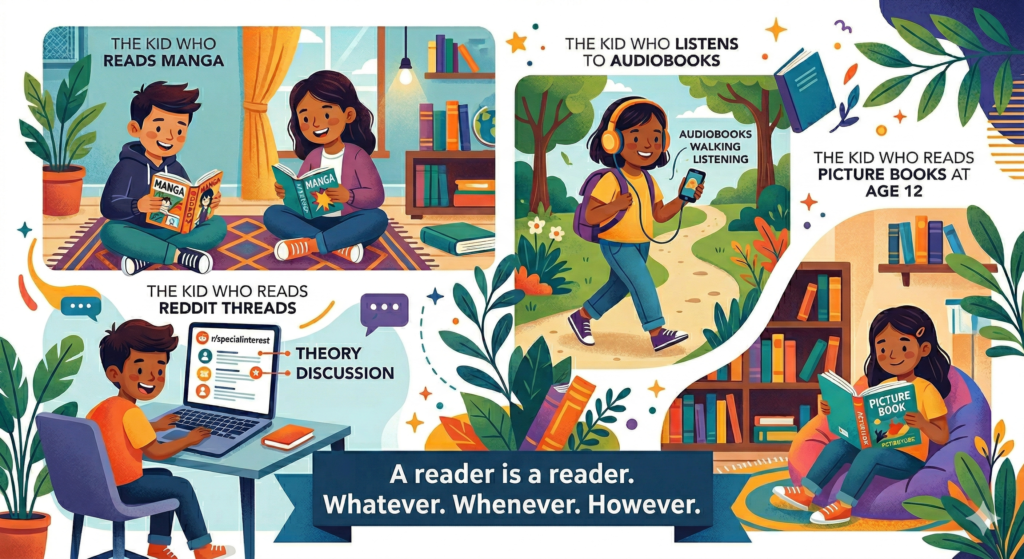
Different formats, different levels, different paces. All of it counts. All of it builds the neural pathways that make reading easier. All of it helps kids reading for fun become a habit again, not a chore.
Reading Rockets has smart resources on building reading motivation, and the core message is consistent: you build motivation by honoring choice, removing shame, and meeting kids where they are instead of where you think they should be.
What Actually Gets Kids Reading for Fun Again
The trap most parents fall into is trying to force reading motivation by controlling choices. You push them toward “better” books. You limit screen time hoping they’ll default to reading. You nag them about not reading. You suggest instead of accepting. And every single thing you do makes reading feel like something that’s being done to them, not something they get to do.
The actual fix is counterintuitive. You have to let go of the steering wheel.
Shanahan on Literacy has a whole piece on making kids love reading, and it keeps coming back to the same point: freedom and choice are not luxuries. They’re the foundation of a reading identity.
This doesn’t mean zero boundaries. You can still have screen time limits. You can still prioritize reading time. It means shifting from “you should read this” to “what do you want to read?” It means accepting graphic novels and manga without the internal commentary that they’re somehow lesser. It means letting them listen to audiobooks. It means watching them disappear into a series about something you find absolutely baffling (Minecraft fan fiction? Really?) and being genuinely thrilled about it anyway.
Because a kid who’s reading about something they care about, in any format, is getting their reading identity back. And that identity is everything.
This Week’s Action Step
This week, take your child to a library or bookstore with zero agenda. No steering. No “wouldn’t you rather try this?” No judgment about what they pick.
Let them choose whatever they want. Graphic novels, manga, nonfiction about their special interest, a book their friend recommended, a series you’ve never heard of, whatever. Your only job is to check it out or buy it and get out of the way.
Choice is the first step back to a reading identity. A kid who sees themselves as a reader will read for fun. And that’s the whole point. (If your child’s reading struggles go beyond motivation, learn what different reading errors actually mean.)
About Decoding Mom
Decoding Mom is written by a mom of a bright kid with ADHD and mild dyslexia. After too many late-night research binges trying to make phonics fun, she started this site to translate the science of reading, IEPs, and special-ed assessments for parents figuring it out the hard way. Honest, parent-first, no fluff. More about her here →
Leave a Reply