“They’re doing it on purpose.”
If you’ve had that thought, you are not alone. I’ve had it. Most parents of kids with ADHD have had it, usually somewhere between the third request to put on shoes and the full meltdown because someone cut the toast wrong.
But here’s the thing: most of the time, they’re not doing it on purpose. They’re doing it because their nervous system has run out of room.
That’s not an excuse. It’s a mechanism. And once you understand the mechanism, the whole thing gets a lot less personal, and a lot more solvable.
Here are five common ADHD behaviors that look a lot like defiance but are actually nervous system responses to overwhelm. Understanding what’s underneath changes how you respond.
Why Behavior Looks Like Defiance in Kids with ADHD
Before we get into the specific behaviors, it helps to understand what’s driving them.
Research on ADHD and emotional dysregulation has found that kids with ADHD experience emotions more intensely and have more difficulty regulating those emotions than their neurotypical peers. A study published in ADHD Attention Deficit and Hyperactivity Disorders found that emotional dysregulation is one of the most impairing aspects of ADHD in children, affecting everything from peer relationships to academic performance to family dynamics.
The behaviors we’re about to look at all trace back to that same root: a nervous system that is overwhelmed and trying, in the only ways it knows, to cope. That doesn’t mean no boundaries. It means the strategy you use has to match what’s actually happening.
1. “I’m Bored” Then Rejecting Every Idea You Offer
Your child announces they’re bored. You suggest ten things. They reject every single one. You feel like you’re being messed with.
You’re not. What looks like pickiness is actually difficulty with initiation and interest regulation, two areas where ADHD makes life genuinely hard. The ADHD brain struggles to activate on tasks that don’t already have momentum or built-in engagement. “I’m bored” often translates to “I can’t get myself started and I don’t know how to get the engine going.”
The rejection of your suggestions isn’t ingratitude. It’s that none of your options feel accessible because the initiation problem is still in the way.
What helps: instead of offering a menu of options, do the first step with them. Not “do you want to draw or go outside?” but “let’s go outside for two minutes and see what happens.” The first thirty seconds of doing something is often the hardest part. Once the engine turns over, it usually keeps going.
2. Getting Hyper or Silly Right Before Bed
You’ve made it through dinner. Bedtime is close. And then your child turns into a completely different person: giggling at nothing, bouncing off the walls, picking fights, unable to settle.
This is not a second wind and it is not manipulation. Transitions are genuinely hard for kids with ADHD, and the transition to sleep is one of the hardest. The ADHD nervous system doesn’t have a smooth off switch. The silliness and hyperactivity are regulation attempts. The brain is trying to process the shift from “going” to “stopping,” and it doesn’t know how to do that quietly.
What helps: extend and soften the transition window. The goal isn’t less time before bed; it’s a longer runway. Dim lights earlier, shift to quieter activities twenty to thirty minutes before actual bedtime, and avoid screens or high-stimulation activities in that window. Movement followed by calm, in that order, tends to work better than trying to skip straight to calm.
3. “I Can’t Do It!” Before They’ve Even Tried
You ask your child to do something reasonable. Their homework. Their chores. Getting dressed. Before you’ve finished the sentence, they’re already in tears or already melting down. “I can’t do it. It’s too hard. I don’t know how.”
This one looks like drama. It’s actually overwhelm.
Tasks that seem simple to us can appear cognitively enormous to a child with ADHD. The executive function system that helps break a task into steps, sequence those steps, and initiate the first one is the same system that ADHD affects most directly. Without that scaffolding, “do your homework” lands as one massive, undifferentiated wall.
“I can’t do it” isn’t giving up before they’ve started. It’s a nervous system that has already assessed the task as too big to navigate and is signaling distress.
What helps: shrink the task until the first step feels genuinely manageable. Not “do your homework” but “take out your math worksheet.” Not “clean your room” but “pick up the things on your floor that belong in the bathroom.” The first step should be so small it almost doesn’t count. That’s on purpose. You’re not lowering expectations; you’re helping them find the door.
4. Smiling or Laughing When You’re Correcting Them
You’re addressing a behavior, calmly, you’ve got your regulated-parent voice going, and your child smiles. Or laughs. Right at you.
In the moment, nothing feels more disrespectful. But this is almost never defiance. It’s an involuntary stress response.
According to Healthline’s reporting on nervous laughter, the nervous system uses laughter as a mechanism to regulate uncomfortable emotional states. It’s not voluntary, and it’s not a sign that the child doesn’t take the correction seriously. For kids with ADHD, whose nervous systems are already running hot and whose emotional regulation systems are already stretched, a correction can tip them into a stress response that comes out as laughter.
They’re not laughing at you. Their nervous system is trying to manage the discomfort of being corrected.
What helps: stay calm and don’t escalate over the laugh. Name the behavior you want to address, keep the conversation brief, and if possible, circle back to a deeper conversation later when both of you are regulated and out of the moment. Trying to muscle through a full correction conversation while a child is in a stress response doesn’t tend to work. The message doesn’t land; it just adds to the dysregulation.
5. Big Meltdowns Over Small Things After School
The school day is over. Your child walks in the door. You say something completely neutral. Or they discover their snack isn’t what they wanted. Or their sibling looks at them wrong.
And it falls apart completely.
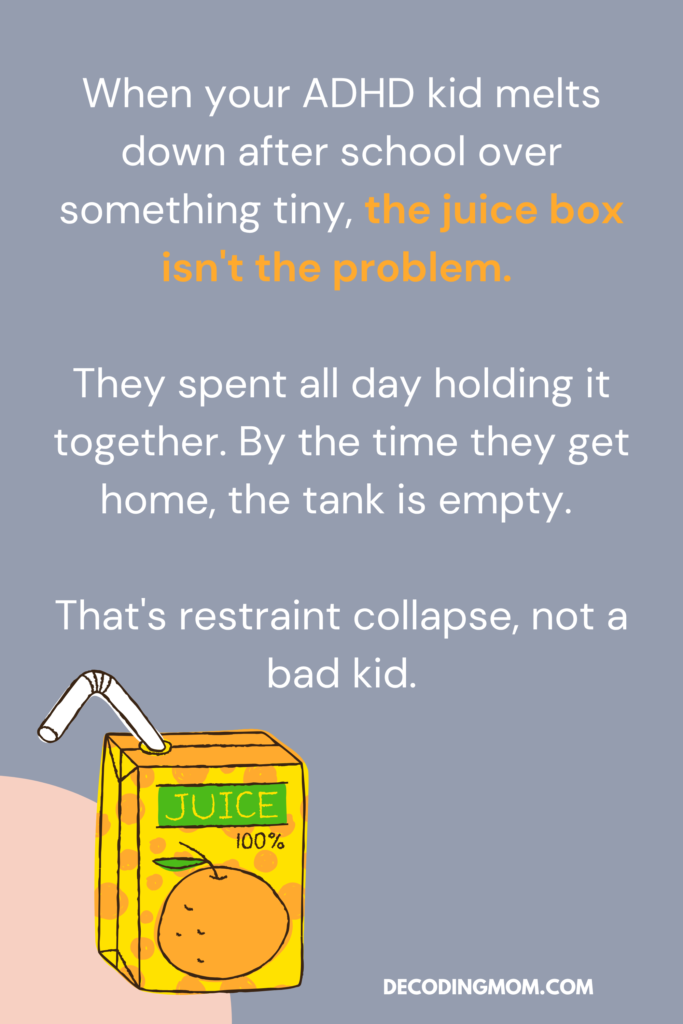
This one is called after-school restraint collapse, and it is extremely common in kids with ADHD. CADDAC (Centre for ADHD Awareness Canada) explains it this way: children with ADHD spend the entire school day working incredibly hard to hold it together. They’re suppressing impulses, managing sensory input, navigating social dynamics, and trying to meet behavioral expectations in an environment that wasn’t really designed for their nervous system. By the time they get home, their emotional reserves are gone.
The juice box wasn’t the problem. The juice box was just the last straw on a nervous system that has been running on fumes since second period.
What helps: build in a decompression window immediately after school. Not homework. Not chores. Not a conversation about the day. Snack, low-demand activity, no requests. Twenty to thirty minutes of no-pressure time lets the nervous system come down before you ask anything of it. Think of it as emotional refueling. The homework conversation will go significantly better if you wait.
The Shift That Changes Everything
When you move from “they’re doing this on purpose” to “their nervous system is overwhelmed and trying to cope,” your whole response changes. You stop taking it personally. You start looking for the mechanism underneath.
That shift doesn’t mean no limits. Kids with ADHD still need structure, clear expectations, and consistent follow-through. It means the strategy you use has to match what’s actually happening in their nervous system at that moment.
A child in overwhelm can’t process consequences the same way a regulated child can. A child in a stress response can’t hear a correction the way a calm child can. That’s not a reason to abandon expectations. It’s a reason to sequence the approach differently: regulate first, then address the behavior, then problem-solve together.
Every single one of these behaviors has a nervous system explanation. And every single one of them responds better to support than to punishment.
Action step: The next time you see one of these behaviors, pause before you respond. Ask yourself: what might their nervous system be trying to manage right now? Even thirty seconds of that question before you react can change the whole trajectory of what happens next.
About Decoding Mom
Decoding Mom is written by a mom of a bright kid with ADHD and mild dyslexia. After too many late-night research binges trying to make phonics fun, she started this site to translate the science of reading, IEPs, and special-ed assessments for parents figuring it out the hard way. Honest, parent-first, no fluff. More about her here →
Leave a Reply