When your child makes a reading error, the instinct is to wince and correct it. Maybe you count how many mistakes they made on a page, or notice the look on their face when they stumble over something they feel like they should know. It’s hard to watch. And if you’re anything like me, your brain starts spinning: Is this normal? Is this getting worse? What do we do?
Here’s something that changed how I think about this entirely: reading errors are not just mistakes. They’re information. The specific shape of an error, not just that an error happened, tells you something meaningful about what’s happening inside your child’s reading system. And once you know how to look at errors differently, you become a much better advocate for your child.
You don’t need a master’s degree in literacy for this. You just need to know what the three main categories of reading errors actually are.
Why Error Patterns Matter More Than Error Count
Most parents (and honestly, a lot of school reports) focus on how many errors a child made. But quantity tells you almost nothing useful. What tells you something useful is the pattern.
Think of it like a doctor looking at symptoms. A cough is a cough, but a dry cough is different from a wet one, and both are different from a cough that only happens at night. The symptom points the doctor toward a specific cause. Reading errors work the same way.
According to the International Dyslexia Association, effective reading instruction for kids with dyslexia and related reading difficulties has to be diagnostic, meaning it needs to start with understanding what specific skills are breaking down. A child who is struggling because of phonological deficits needs different instruction than a child who is struggling because their orthographic knowledge is weak. Same symptom on the surface. Very different root causes.
So what are the three layers? Let’s walk through them.
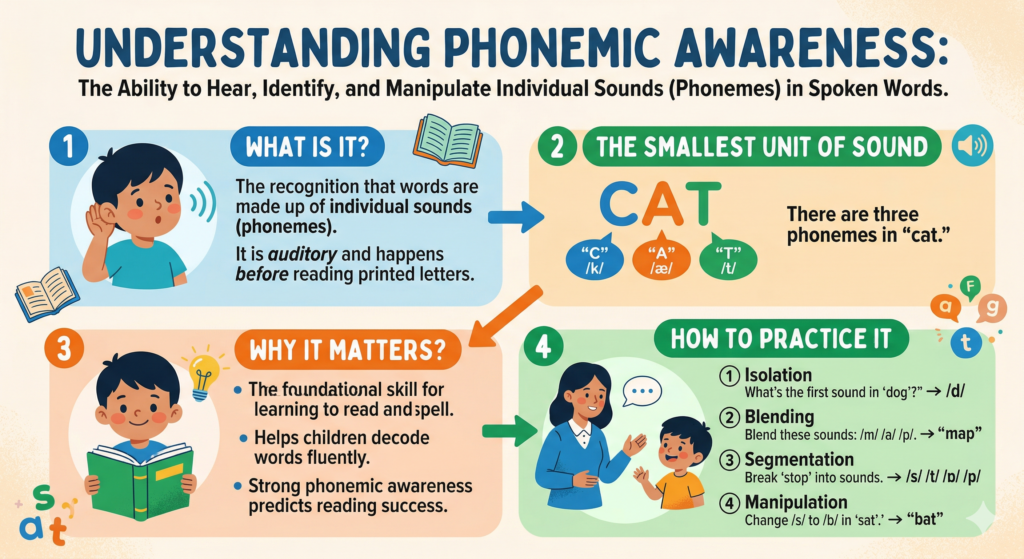
Layer 1: Phonological Errors (The Sounds Are Missing)
Phonological processing is your brain’s ability to hear, manipulate, and work with the individual sounds in spoken language. When this layer is shaky, errors tend to look like the sounds are falling apart.
You might see your child write “mlik” instead of “milk,” or read “bup” when the word is “bump.” Consonant clusters are especially tricky. The child might drop a sound entirely, reverse sounds within a word, or blend incorrectly. The word they produce sounds something like the target word, but the sound structure is wrong.
These errors are telling you something specific: the child’s phonemic awareness, their ability to hear and manipulate individual sounds, needs direct, explicit instruction. Reading Rockets has a thorough breakdown of what phonological awareness instruction looks like at different levels, from basic rhyme recognition all the way to phoneme manipulation. If your child’s errors are primarily phonological, the intervention focus should be on the sound layer of language, not just on more reading practice.
This is also the most common error pattern in kids with dyslexia, which is why phonological processing is considered the core deficit in dyslexia research.
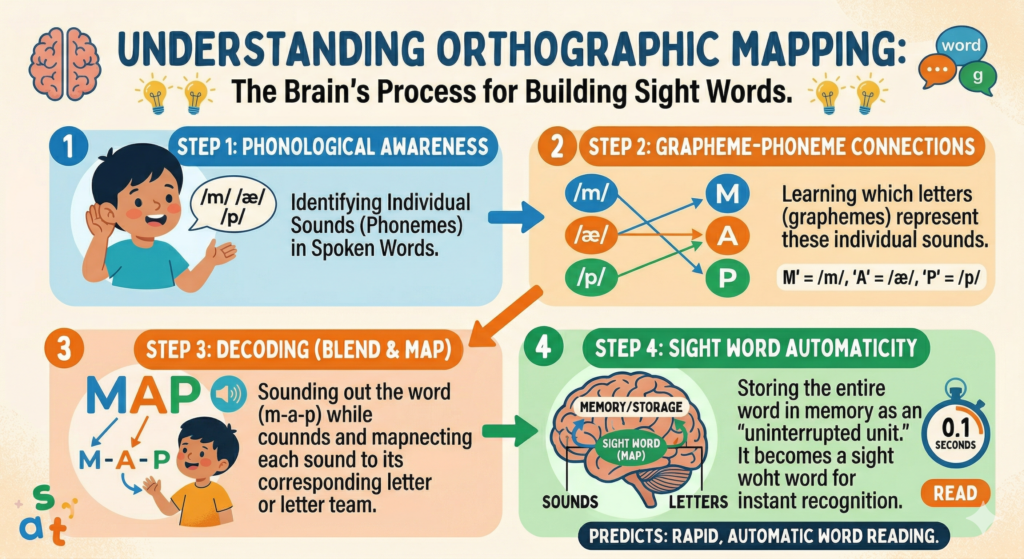
Layer 2: Orthographic Errors (The Sounds Are Right, But the Spelling Pattern Is Wrong)
Orthographic knowledge is understanding how the writing system works: vowel teams, spelling conventions, patterns that govern how sounds get represented in English. When this layer is underdeveloped, errors look different from phonological ones.
Here the sound is right, but the spelling pattern is off. A child might write “treet” for “treat,” or “nite” for “night.” They’re getting the pronunciation correct, but they don’t have the spelling pattern stored. They’re making a reasonable phonetic guess rather than drawing on an established orthographic memory.
You might also see this with homophones: “their/there/they’re” all sound correct when read aloud, but a child with orthographic weaknesses will swap them in writing without knowing why. Or they’ll decode “sign” as “sinn,” because they don’t have the silent-g pattern mapped.
The Dyslexia Training Institute describes orthographic dyslexia as a pattern where phonological skills can be intact, but orthographic processing is the bottleneck. This matters because a child with this profile can sometimes look fine on basic phonics assessments but still struggle significantly with fluency and spelling. Instruction for this layer means explicit teaching of vowel teams, common spelling patterns, diphthongs, and the rules and exceptions that govern English orthography.
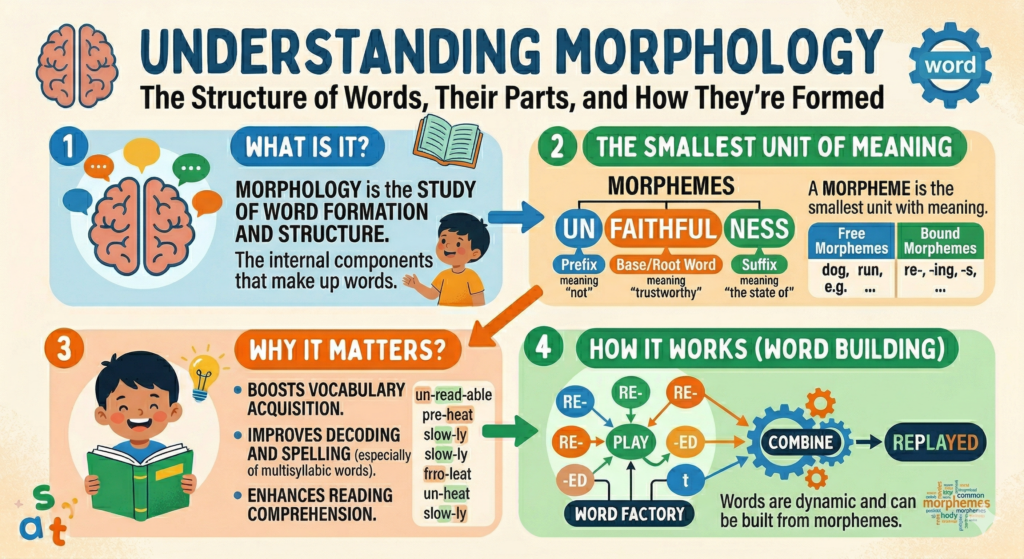
Layer 3: Morphological Errors (Units of Meaning Are Getting Dropped)
Morphology is the study of meaningful word parts: prefixes, suffixes, roots, and base words. Morphological awareness means understanding that “slowly” is made of “slow” plus “-ly,” that “wishes” is “wish” plus “-es,” and that those additions mean something specific and predictable.
When this layer is weak, errors tend to look like word endings are being dropped or distorted. A child might read “slowly” as “slowlee,” or write “wishiz” for “wishes,” or read “jumped” as “jump” without the past-tense marker. They’re not ignoring the ending entirely, but they haven’t internalized that the ending is a meaningful unit with its own rules.
Morphological awareness research from the University of Michigan’s Dyslexia Help notes that this is often an underfocused area in early reading intervention, even though it becomes increasingly critical as kids move into longer, more complex words in third grade and beyond. Explicit morphology instruction, learning roots and affixes as meaningful, reusable units, can dramatically improve both reading fluency and spelling for kids who struggle here.
Why One Size Does Not Fit All
Here’s the thing: most struggling readers don’t fit neatly into one category. A child might have solid phonological awareness but weak orthographic mapping. Another might have phonological deficits and emerging morphological awareness. The mix matters.
This is exactly why reading intervention shouldn’t be a generic program that every struggling reader cycles through. It should be built from an understanding of where that specific child’s system is breaking down.
The good news is that this kind of error analysis doesn’t require a specialized assessment, though those are useful. You can learn a lot by simply listening carefully to your child read aloud, and reading carefully through their writing samples.
Right Track Reading’s analysis of actual reading errors makes the point well: the child who is not processing print phonetically and the child who has incomplete code knowledge look different if you know what you’re looking for. You’re not looking for how many errors. You’re looking for the shape of them.
What to Bring to Your Child’s Team
If your child is in reading intervention, ask their specialist this: “Can you walk me through what types of errors you’re seeing in your assessments? Are these primarily phonological, orthographic, or morphological?” A good intervention teacher should be able to answer this clearly, and their answer should connect directly to what they’re focusing on in instruction.
If they can’t answer it, or if the answer is “we’re just working on reading more,” that’s useful information too. It might mean the intervention isn’t diagnostic, and that’s worth pushing on.
You can also do your own informal observation. Sit down with your child and a book that’s slightly challenging, not so hard it’s frustrating, but hard enough that they’re working. Take notes on what you hear. Are they dropping sounds? Getting the sounds right but spelling patterns wrong in their reading attempts? Dropping word endings?
Even a few minutes of careful observation can give you a clearer picture than weeks of counting errors on homework sheets.
Start Looking at the Shape, Not Just the Number
Reading errors aren’t proof that your child isn’t trying or isn’t smart. They’re data. They’re your child’s reading system sending up signals about where it needs support. Learning to read those signals changes how you talk to teachers, how you evaluate intervention programs, and how you understand your child’s experience.
You don’t have to become a reading specialist. But you can become the parent who pays attention to patterns, and that skill is genuinely powerful when you’re sitting across a table at an IEP meeting or talking to a reading interventionist.
Action step: Save a writing sample from your child this week, or record a brief read-aloud session on your phone. Look at the errors, not how many there are, but what kind they are. Do they involve sounds falling apart, spelling patterns being guessed, or word endings being dropped? Bring what you notice to your child’s next meeting with their reading teacher or specialist.
About Decoding Mom
Decoding Mom is written by a mom of a bright kid with ADHD and mild dyslexia. After too many late-night research binges trying to make phonics fun, she started this site to translate the science of reading, IEPs, and special-ed assessments for parents figuring it out the hard way. Honest, parent-first, no fluff. More about her here →
Leave a Reply