You opened the email. Your kid is “On Grade Level.” There was that small flicker of relief. Then you sat down to read with him after dinner and watched him stumble through three sentences that week’s decodable reader.
Both things can be true at the same time. The screener says On Track and your kid is off the rails on the foundational skills the screener says they have. There is a name for what is happening, and once you can see it, you can ask the school the right questions.
It is called the masking pattern. It shows up most often in the kids who are hardest to advocate for. The smart ones. The talkative ones. The kids who read above grade level when you read TO them but stall the moment they have to decode the page themselves.
I lived this for almost two years before I understood what was going on. My kid kept “passing” the reading screener. The dashboard kept saying On Track. Every weekend I was watching him struggle with the books his classmates were tearing through. I thought I was the problem. Then I started reading the actual research.
The Single Score Lies, Politely
Most adaptive reading screeners (i-Ready, MAP, you have seen the names) give you one big number for reading. A scale score, a percentile, a placement label. That single number is calculated by averaging your kid’s performance across several reading domains:
- Phonological awareness (the foundation: hearing and manipulating sounds in spoken words)
- Phonics (mapping sounds to letters)
- High-frequency words (the words English readers see most often)
- Vocabulary
- Comprehension
For a typical reader with no underlying weakness, the math works. The domains tend to move together. The composite is a reasonable summary of where the kid is.
For a kid with a twice-exceptional profile, or a dyslexia profile, or any reader whose strengths and weaknesses do not track each other, the domains do not move together. Your kid scores in the top quarter on vocabulary because they have a rich oral language environment and a brain that catches and holds words once they hear them. They score in the bottom quarter on phonological awareness because they cannot reliably break a word into its individual sounds. They score in the middle on phonics because they are guessing from context and pictures.
Average those scores. You get a reasonable-looking number. A composite that lands at the 50th percentile and gets labeled On Grade Level.
Your kid is not on grade level for the skills that determine whether they will be a reader. They are on grade level on average, because their strengths are pulling the number up while their weaknesses are pulling it down. The math works. The conclusion does not.
What the Algorithm Adds On Top
If averaging were not enough, adaptive testing layers a second problem on top.
An adaptive test branches based on how your kid answers early items. If they score well enough on phonics, the algorithm decides additional phonological awareness items are “not necessary.” Those items never get presented. Your kid never sees the questions that would have shown what they actually know about manipulating sounds. The phonological awareness domain gets a label like “Surpassed Level” that was generated by the algorithm’s inference from a related skill, not by anything your kid actually did.
This is built into the design. It is not a bug. The vendor publishes their own white paper defending the approach. Their argument is that for a typical reader, you do not need to keep testing PA past first grade because phonics performance can stand in for it.
That argument holds for a typical reader. It does not hold for the kid whose phonics score was inflated by compensating strategies in the first place. For that kid, the algorithm is using one symptom of the problem to “rule out” another symptom of the same problem.
What This Looks Like In Real Data
Here is a real reading trajectory across eight testing windows.
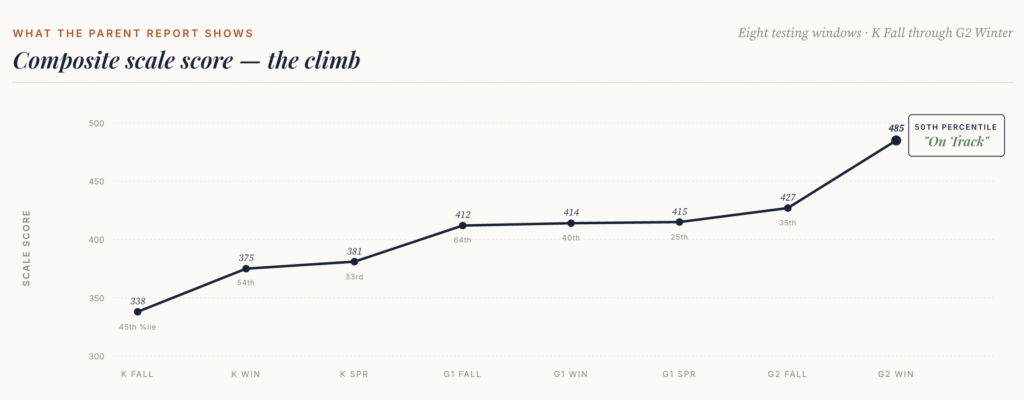
Across two and a half years of testing, the composite scale score climbed from 338 to 485. The percentile landed at the 50th. The placement read On Track.
Underneath, the phonological awareness scale score went from 350 in kindergarten fall, peaked at 435 in first-grade winter, then declined for three consecutive windows: 406, 394, and SKIPPED. The algorithm decided in the most recent testing window that PA did not need to be measured anymore. Phonics gained a net fifteen points across a year and a half of school, while typical first-grade phonics growth on the same scale is closer to fifty.
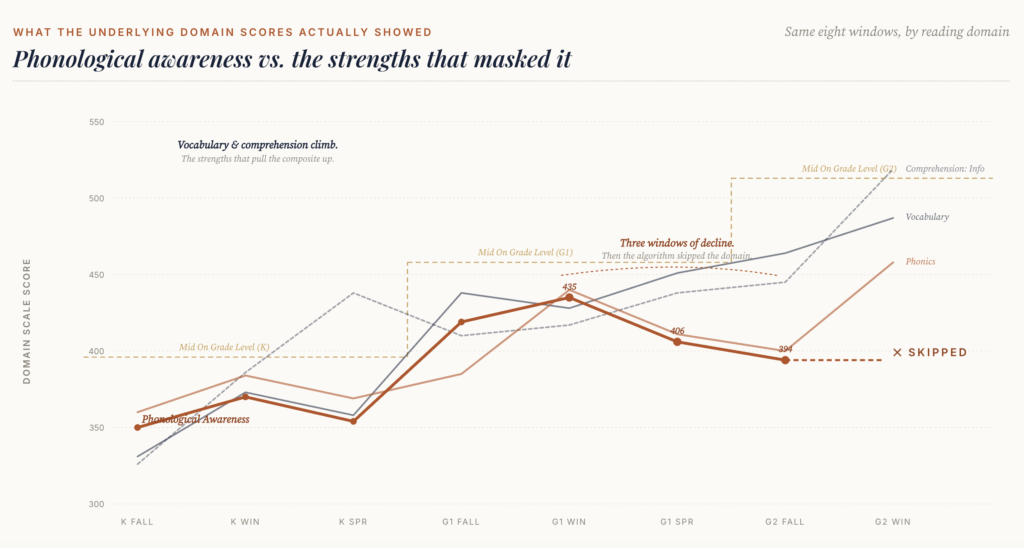
The composite did exactly what a composite does. It averaged a struggling decoder with a strong listener. It produced a single number. The number said fine.
How to Spot the Pattern in the Kid You Already Know
The parent report you get does not show you any of this. It shows you the composite score, the percentile, the placement label, and a row of color bars. The underlying data lives in the educator dashboard. The trends, the skipped domains, the per-window scale scores, all of it sits in the version of the report your kid’s school is looking at, not the version they sent home.
But there are tells you can spot in the kid you already know:
- They read above grade level when you read TO them. They stall when they read alone.
- They can answer comprehension questions about a story you just read aloud. They cannot read the same story themselves.
- Their vocabulary is rich. Their spelling is phonetic and wrong (for example, “ckat” for “cat” or “prite” for “pretty”).
- Homework that the teacher said should take 15 minutes is taking 45.
- They avoid books they used to love. They suddenly need you to read everything aloud.
Each of those, alone, is just a thing kids do. Together, in a kid whose composite reading score keeps coming back On Track, they are the masking pattern showing up at home before the dashboard catches up to it.
The behavioral indicators are not just my anxious-mom observation. The Michigan Department of Education’s own dyslexia handbook lists five behaviors that should trigger a dyslexia screening regardless of test results. Most of those five overlap with what a lot of parents are already seeing at home, three years before anyone at school catches the pattern in the data.
What to Do This Week
Send a written request to your child’s school (teacher or admin) asking for the complete diagnostic data. Not the parent report. The underlying scale scores by window, for every reading diagnostic your child has taken, plus any growth metrics, “On Watch” indicators, or risk flags from the educator view.
Most schools will be happy to send over the info. If you get pushback, though, remember that you have a right to that data under the Family Educational Rights and Privacy Act. The school has a legal timeline to respond, typically 45 days. The records they have to give you include the educator-view data, not just the parent-view summary.
When the data comes back, look at three things:
- Trends within each domain across all the testing windows. Is the line going up, flat, or down?
- Gaps between domains. How big is the difference between your kid’s strongest skill area and their weakest?
- Skipped domains. Are there testing windows where one or more domains was not measured at all?
That is the picture the parent report did not give you. It is also the picture you need to make the case for what to ask for next.
Part of the Tests hub. For parent-friendly framing of how testing works in special education and what to push back on, see What You Need to Know About Tests.
About Decoding Mom
Decoding Mom is written by a mom of a bright kid with ADHD and mild dyslexia. After too many late-night research binges trying to make phonics fun, she started this site to translate the science of reading, IEPs, and special-ed assessments for parents figuring it out the hard way. Honest, parent-first, no fluff. More about her here →
Leave a Reply