Your kid can sound out words now. They passed the phonics screener. They’re not stumbling over “ch” and “th” anymore. So why are they still struggling with reading?
You’re not imagining it. And you’re definitely not alone.
Over the past five years, we’ve heard a lot about the “science of reading” and phonics. It’s been the big fix, the magic bullet, the thing that was going to transform struggling readers everywhere. And phonics absolutely matters. But here’s what nobody told you: phonics is necessary but it’s not sufficient.
Let me explain what I mean, because this matters for how you think about your kid’s reading moving forward.
The Phonics Ceiling
When Tim Shanahan, one of the leading researchers on reading instruction, looked at the data, he found something striking: more than 50% of struggling readers whose decoding skills improved to grade level still struggled with reading comprehension. They could sound out the words. They could decode. But they couldn’t understand what they were reading.
Think about that for a second. The thing we fixed didn’t fix the whole problem.
This is where the Simple View of Reading comes in, and honestly, once you understand this framework, a lot of your kid’s reading journey starts to make more sense. The Simple View of Reading says that reading comprehension is the product of two separate things: decoding and language comprehension. You multiply them together. And if either one is weak, your reading falls apart.
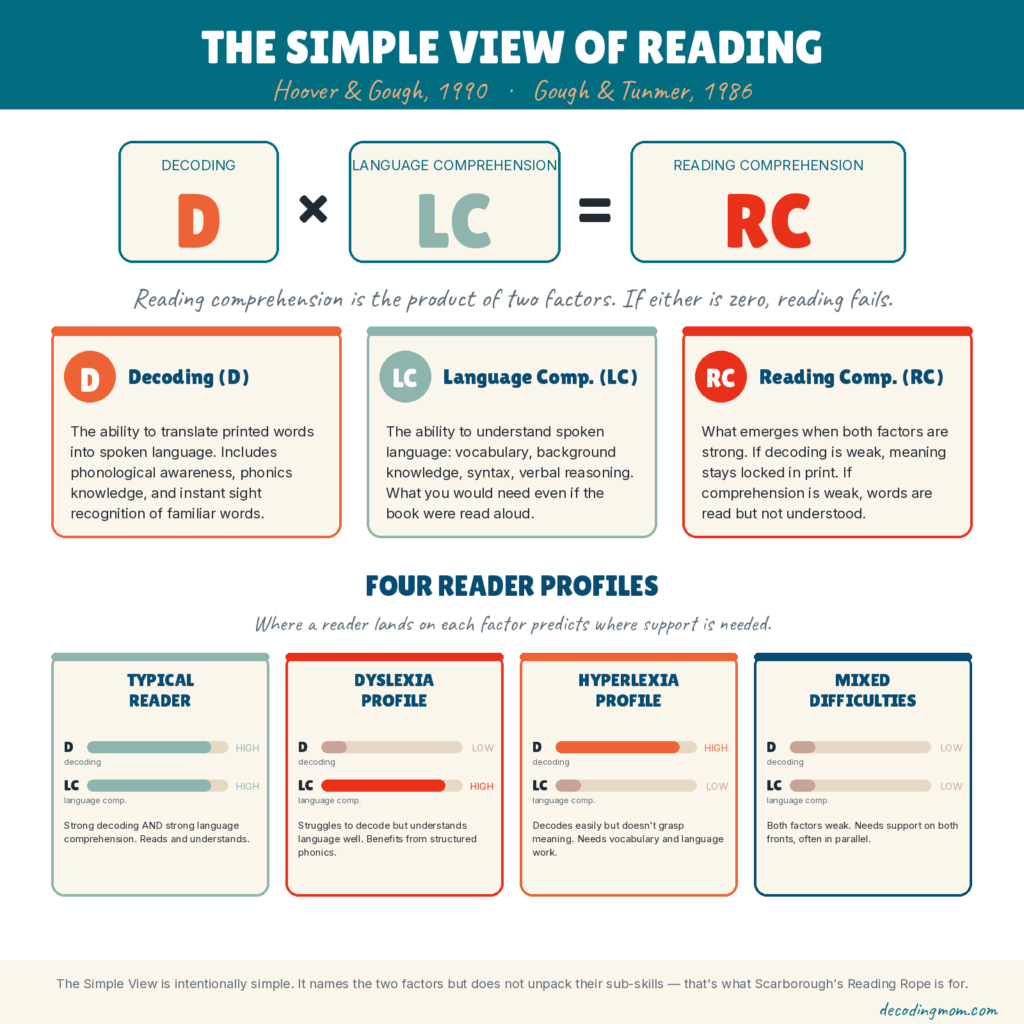
We’ve spent the last five years focused almost entirely on the left side of that equation: decoding. Phonics. Sounding things out. It’s important. But there’s a whole other side, and that’s what we’ve been quietly neglecting.
The Five Pillars, Not Just One
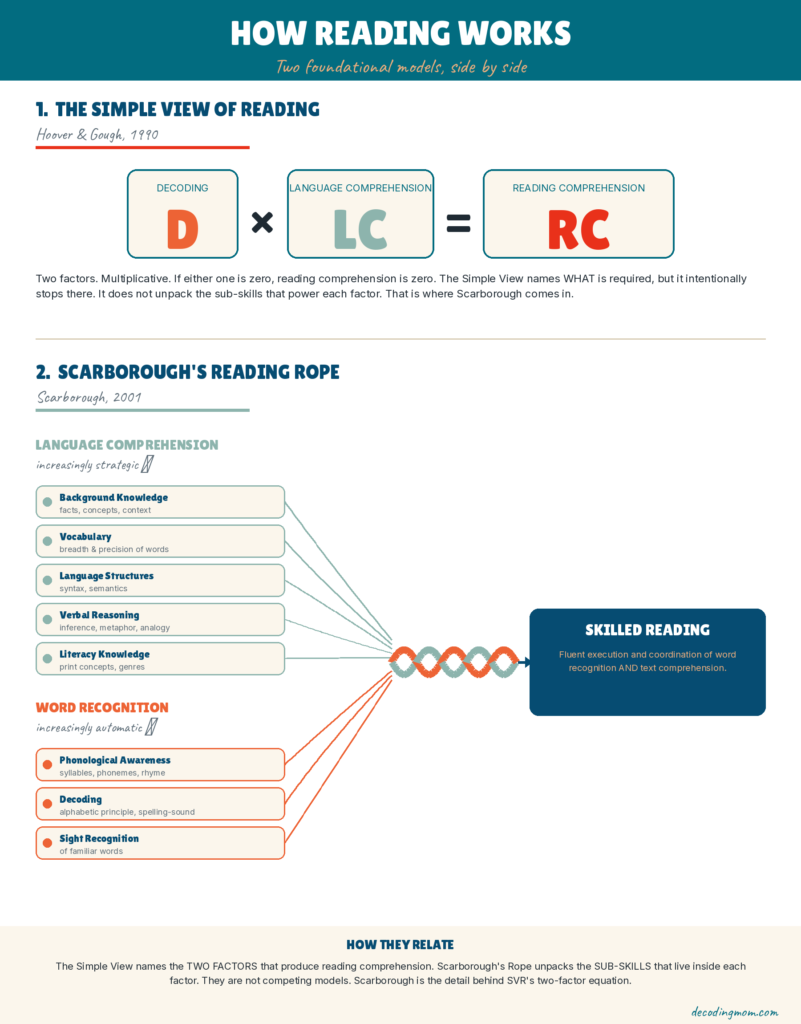
The National Reading Panel identified five components of reading instruction: phonics, phonological awareness, fluency, vocabulary, and comprehension. We talk about phonics constantly. We’re all fluent with fluency now. But vocabulary and comprehension? Those got buried.
Here’s the honest part: the data from the National Assessment of Educational Progress shows that reading scores haven’t dramatically improved despite phonics reforms. We did phonics. We did it well, in a lot of cases. And reading still isn’t where we want it to be.
Why? Because kids who can’t decode need phonics. But kids who can decode need something else. They need vocabulary. They need background knowledge. They need to understand the world enough to make sense of what they’re reading.
Dan Willingham’s research is crucial here. He argues that reading comprehension is fundamentally dependent on background knowledge. You can’t understand a story about a farmer if you don’t know what farmers do. You can’t understand a passage about the water cycle if you haven’t built mental models about how weather works. The words themselves aren’t enough.
Your Kid Can Sound Out Words but Not Understand Them
This is the frustration I hear from parents all the time, and now you know why it’s happening.
Your child decodes. They might even read fluently. But they read a paragraph and can’t tell you what happened. They read a chapter and you ask them about it and they look blank. They can access the words but not the meaning.
Sometimes they didn’t know the vocabulary. Sometimes they lack the background knowledge to understand what the text is assuming they already know. Sometimes they didn’t make the inferential leaps the text required.
This is not a decoding problem. Phonics isn’t going to fix this.
A comprehensive analysis of reading research shows that comprehension interventions that build knowledge and vocabulary are essential for readers whose decoding has improved. Your child has already gotten the phonics piece. Now they need the other half.
What You Can Actually Do at Home
The good news is that this is something you have enormous control over.
You can build vocabulary and background knowledge. You don’t need a special program or intervention. You just need to be intentional about it.
The most powerful tool you have is read-alouds. And here’s the key: read something above your child’s independent reading level. Not at their level. Above it. This is how you build vocabulary in context. You’re exposing them to richer language, more complex sentences, ideas they haven’t encountered yet.
Reading Rockets has excellent guidance on building background knowledge through read-alouds. The science is clear: when you read aloud to kids, you’re not just entertaining them. You’re building the scaffolding they need for reading comprehension.
Talk about the ideas. Don’t just read and move on. Ask questions. Make connections. “Did you know that penguins live in Antarctica? It’s at the very bottom of the world, and it’s freezing cold.” You’re not quizzing your kid. You’re thinking out loud together.
Pick topics they’re interested in. If your kid loves dinosaurs, read dinosaur books. If they’re fascinated by how things work, find books about engineering and mechanics. If they’re curious about space, go there. Research on how to improve literacy emphasizes a broad range of skills, including building genuine interest in reading topics.
Talk to them. A lot. About everything. Describe things. Explain how things work. Use interesting vocabulary naturally. You’re building their language comprehension while you’re living your life. This is the invisible work of reading preparation.
Don’t assume that because phonics is handled, you’re done. You’re not. You’re just starting the part where your child learns to think about what they’re reading.
What This Means for School
You might find that your child’s school is still focused primarily on phonics and decoding, even though they’ve moved past that. This is where you come in as the parent advocate.
Ask questions. Find out what books, whole books, your child is actually reading in class. Is it excerpts in a basal reader, or is it actual books? Is there time spent building knowledge about topics? Are they having conversations about ideas?
This isn’t about criticizing your child’s school. It’s about understanding what’s happening and knowing where you can fill the gap.
Your child’s reading level is not their ceiling. There’s so much more possible once you move past the decoding question.
One Thing to Do This Week
Read something to your child that’s above their independent reading level. A chapter book. A nonfiction article about something they’re curious about. It could be a book you think is interesting. It could be something they asked you about. Pause and talk about the ideas. Ask them questions. You’re not drilling anything. You’re building the foundation for reading that goes deeper than decoding.
This is the invisible work. This is how reading actually grows.
About Decoding Mom
Decoding Mom is written by a mom of a bright kid with ADHD and mild dyslexia. After too many late-night research binges trying to make phonics fun, she started this site to translate the science of reading, IEPs, and special-ed assessments for parents figuring it out the hard way. Honest, parent-first, no fluff. More about her here →
Leave a Reply