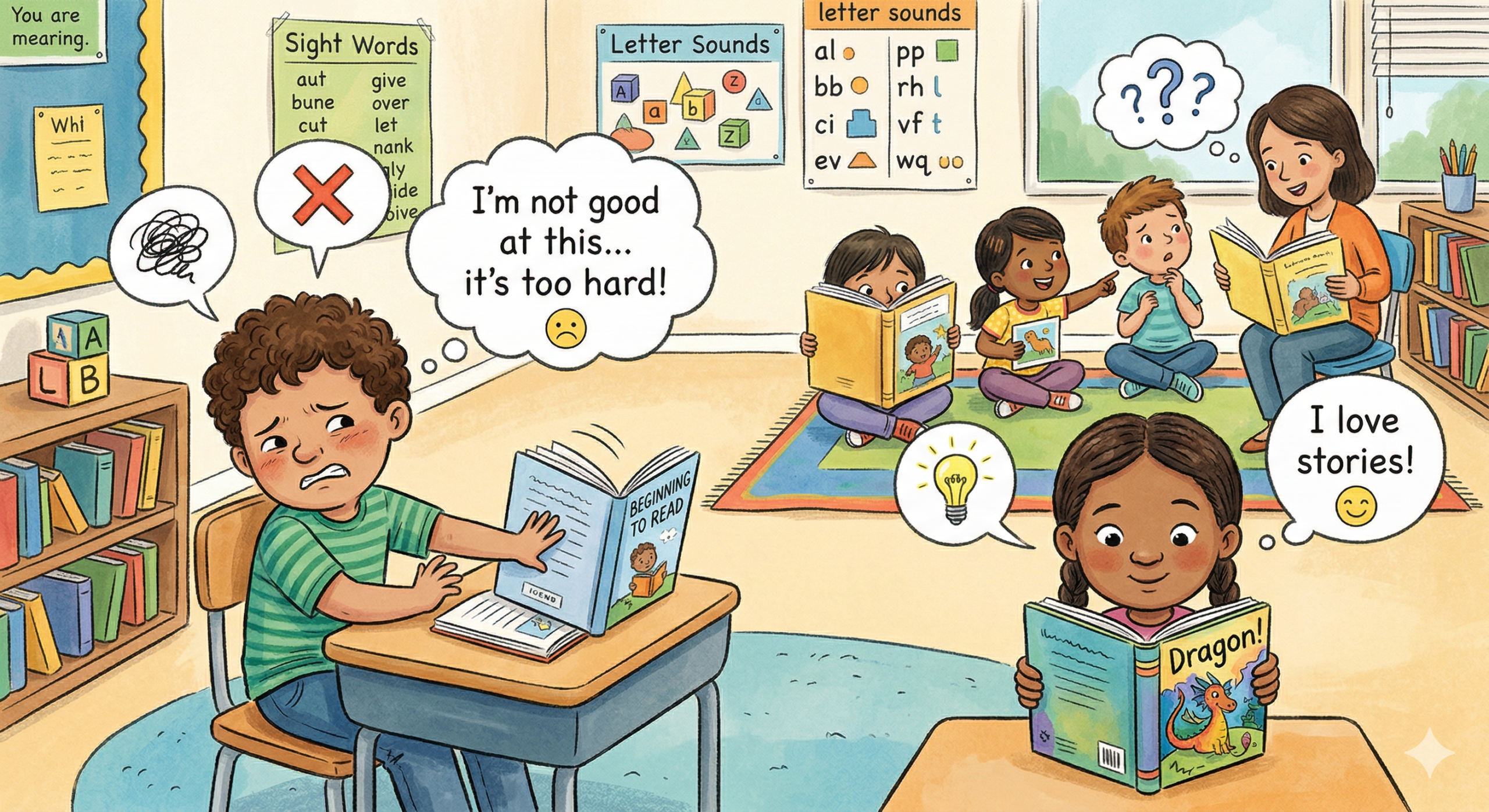
When a child with ADHD is struggling to read, the first question almost everyone asks is: “What level are they on?”
The teacher asks it. The pediatrician asks it. The reading tutor asks it. You might have asked it yourself at the last parent-teacher conference. And I get it. It sounds like the right question. It sounds specific and measurable and actionable.
But it’s the wrong question. At least, it’s the wrong first question.
I know that feels counterintuitive. We’re all conditioned to think of reading as a skills ladder. Your child is on rung seven, they need to get to rung eight, so you find the program that helps them climb. Makes sense, right? Except that for kids with ADHD, there’s something underneath the ladder that nobody’s looking at. And if you ignore it, you can throw every reading program in the world at this kid and still watch them shut down.
What’s Already Happening Before a Single Word Gets Read
Before your child ever sits down with a book, a reader, or a worksheet, they’re already having a conversation in their head. And for a lot of ADHD kids who’ve been struggling for any amount of time, that conversation sounds something like this: “I can’t do this.” Or: “I’m dumb.” Or: “I’ll just mess up anyway.”
This isn’t drama. It’s not a bad attitude. It’s what happens when a smart kid fails at something repeatedly and publicly for months or years. They build a story about themselves as a reader, and that story becomes the lens through which they experience every future reading task.
Reading Rockets describes this connection clearly in their research overview on reading motivation: self-concept as a reader is one of the most significant factors in whether a child chooses to engage with reading at all. Positive reading self-concept is linked to reading volume, comprehension, and persistence. When that self-concept is negative, the skills a child actually has become much harder to access consistently.
This is the identity piece. And for kids with ADHD, it shows up in a specific, confusing way that often looks like defiance when it isn’t.
What Looks Like “Won’t” Is Usually “Can’t Access Right Now”
Here’s what I’ve come to understand about my own kid, and about ADHD in general: the inconsistency is not defiance. It’s dysregulation.
Your child can read those words perfectly on Tuesday afternoon when they’re calm, interested, and the stakes feel low. They fall apart on Thursday morning when they’re already wound up, the timer is running, and they know you’re watching. Same words. Same skill level. Completely different output.
According to Understood.org, executive function challenges play a significant role in reading access: working memory issues make it harder to hold onto meaning while decoding, flexible thinking problems trip kids up on words with multiple meanings, and attention challenges mean kids may not be able to sustain the focus reading requires, especially under stress. It’s not that the skill disappears. It’s that the conditions for accessing it stopped being available.
So when a child seems to “refuse” to read, or suddenly “forgets” things they knew last week, the useful question isn’t “are they trying hard enough?” The useful question is: are they in a state where they can actually access what they know? Or are they so convinced they’ll fail that their brain has already exited the building?
Understanding this distinction changes everything about how you respond in the moment and how you structure support over time.
The First Real Question to Ask
So here’s what I want you to try before you sign up for another reading program, print another worksheet, or schedule another assessment. Ask your child this: “When you think about reading, what’s the first feeling that comes up?”
Then stop talking. Just listen.
What you’re listening for isn’t a skills assessment. You’re listening for the story they’re telling themselves. Because if that story is “I’m stupid” or “I hate reading” or “it’s hopeless,” you don’t have a reading level problem yet. You have an identity problem. And no decoding program in the world can solve an identity problem on its own.
Research on growth mindset, developed by psychologist Carol Dweck at Stanford, has consistently shown that children who believe their abilities can improve through effort are more likely to persist through difficulty and engage meaningfully with challenging material. The inverse is also true: children who believe they are simply “bad at” something will disengage even when they have the capability, because the risk of trying and failing feels worse than not trying at all.
For kids with ADHD, who often have a complicated relationship with academic tasks and may have internalized years of negative feedback, research on ADHD and self-concept shows that children can develop persistently negative views of their own abilities, sometimes even when those views don’t match objective performance. Helping a child build genuine, experience-based belief that improvement is possible isn’t a luxury add-on to reading intervention. It’s a core component of it.

What to Actually Assess Before Choosing a Program
I’m not saying skip the reading assessment. I’m saying it’s third on the list, not first. Here’s what I’d put above it.
Confidence. What does your child currently believe about their ability to get better? Not just what they can do today, but whether they think improvement is even possible for them. A child who believes growth is possible will approach the same reading task very differently than a child who doesn’t. That belief shapes everything that follows.
Conditions for access. What circumstances actually help your child tap into the skills they have? Time of day matters. Location matters. Whether someone is watching matters. Whether there’s a ticking timer matters. Whether the task feels high-stakes or low-stakes matters. You want to know: what environment gives your child the best chance of performing? Because the most carefully designed reading program in the world won’t land if you’re running it under conditions that trigger shutdown.
Motivation. What does your child actually care about? Not what they’re supposed to care about at their age or grade level. What genuinely interests them right now? There is a meaningful difference between asking a reluctant reader to work through a generic phonics passage and asking them to read about how jets work, or animals, or video game design, or whatever they actually think about at night. Both practice the same skills. One has a fighting chance of keeping their brain online.
You Can Build Both Things at the Same Time
I want to gently push back on the idea that you have to “fix the identity stuff first” and then do reading intervention. That framing makes it sound like you’re on hold for months before any academic work can happen. That’s not what I mean.
What I mean is that the instruction itself needs to be designed with the identity piece in mind. Small wins aren’t just nice to have. They are the mechanism. When a child experiences “I read that whole page and I got it right” six times in a row, they start to update their internal story. Not because you told them they were smart. Not because you gave them a sticker. Because they have real evidence from their own experience that improvement is happening.
That’s the goal. Not just a higher reading level. A child who believes they can get better, because they’ve actually seen themselves get better. Those two things have to move together.
Your Action Step This Week
Before your next reading session, ask your child: “When you think about reading, what’s the first feeling that comes up?” Don’t redirect, correct, or reassure. Just listen to what they say. Whatever comes out, that’s your starting point. Write it down if you can. That answer is the real baseline.
About Decoding Mom
Decoding Mom is written by a mom of a bright kid with ADHD and mild dyslexia. After too many late-night research binges trying to make phonics fun, she started this site to translate the science of reading, IEPs, and special-ed assessments for parents figuring it out the hard way. Honest, parent-first, no fluff. More about her here →
Leave a Reply